Somos Esenciales is a new project by theater-maker Paul S. Flores that documents the stories of Latinx day laborers, domestic workers, and volunteers at the Mission Food Hub impacted by COVID who shared their testimonies with City health officials in San Francisco to advocate for racial justice. In March 2021, Somos Esenciales began a Participatory Action Research (PAR) project with fourteen Latinx volunteers (the Essential Researchers) at the Mission Food Hub who decided to focus their investigations on the mental health impact of the COVID pandemic. Our investigation showed that the Mission Food Hub is a support mechanism for our mental health. Volunteering at the Food hub was a positive and inviting practice to deal with the isolation and stress caused by the pandemic.
The work at the Mission Food Hub is not easy. Over 300 volunteers work hard to fill and distribute 50-pound food boxes to 9,000 people a week. They must also learn to get along with each other despite challenges they face providing services to needy people in a health crisis. When co-lead researcher Adriana Camarena and I asked the PAR group (aka the Essential Researchers) what they have learned by participating in the research activities up to now, many of them agreed that they have learned the value of convivencia.
What is convivencia? It wasn’t a word I was familiar with in my own Spanglish household. In Latin America, convivencia is understood as “living together like family.” The Essential Researchers at The Mission Food Hub learned to treat each other like family despite many differences in customs, citizenship status, countries of origin, religious practices, food preferences, language, and ideas about gender roles. The way I understand convivencia is like working together in community and being more patient with differences of opinion, behavior, and ideology in favor of sustaining the family connection and meeting the shared needs. Convivencia is a cultural practice that helps us reconsider our differences, especially in a time of crisis.
There were several examples of convivencia in our PAR group. Somos Esenciales is made up of Latinx from several countries in Latin America including Guatemala, El Salvador, Mexico, Honduras, and Peru, and a few born in San Francisco. Several members carry on the indigenous religious practices of their ancestors. We have at times opened the group activities by smudging sage, using a feather, honoring the four directions, and saying a blessing. Other members have announced their faith in Afro-Cuban Orishas. Many times, participants opened the activities with evangelical or Pentecostal testimonies about the mighty power of Jesus Christ. Some PAR members have complained about how much talk there is about religion and God in the group; however, everyone respected each other’s faith in a way that allowed us to continue working together despite religious affiliations. We made an agreement to respect each other’s religious backgrounds by silently withholding comments. At the Food Hub all religious practices are acknowledged, respected, and even encouraged.
Another way convivencia is practiced among PAR members is through food pathways. For the first few months of operation in 2020, most Food Hub volunteers as well as the people in line waiting to receive a food box were Spanish-speaking Latinos. As news of the Mission Food Hub spread, however, more Asian community members began to seek food resources at the Hub. Many were Chinese Mandarin speakers. Disagreements arose at the Food Hub between Asians and Latinos, partly because people couldn’t understand each other. Between Mandarin and Spanish speakers, and neither speaking English, there were misunderstandings. Eventually, the quantity of Chinese residents in the food line was so large that the City had to provide Mandarin and Cantonese translators in the food line so folks could access their culturally relevant food.
In addition to providing the staple dietary contents like milk, protein, potatoes, carrots, yogurt, etc., the Food Hub also provides culturally relevant food for Latinos. Staples like masa, plantains, black beans, queso fresco, salsa, tortillas, tomatillos were included in the food boxes. However, some Chinese folks began throwing these items out in the trash. Many Latino volunteers felt this was disrespectful. After several arguments, it became clear that there were also some Latinos who didn’t want the brussels sprouts, or mushrooms or chicken wings which the Chinese folks would take. To appease everyone, Food Hub volunteers suggested a second line and another set of tables to be created where people could exchange food box items for their preference. At that exchange table, Chinese folks could trade their beans and queso fresco for chicken wings and bok choy with Latinos trading their Brussels sprouts for cheese, salsa roja, and tomatillos. The arguments were greatly reduced, and a sense of efficient harmony and convivencia between Chinese and Latinos grew.
Another important way convivencia thrives at the Mission Food Hub is the understanding of gender roles. It is a typical Latino macho instinct that men should lead outdoor work, manual labor, factory work, transportation, and that women should lead indoor work, cleaning work, cooking work. Latino immigrant male day laborers at the Food Hub may not be as familiar taking direction from women on the job. At the Food Hub, this was often challenged as the front-line leader responsible for filling and distribution of food boxes is an immigrant Mexican woman, Connie Rivera, also one of the members of Somos Esenciales. Connie’s leadership is often challenged by the men she manages. Within our own PAR group, research leader Adriana Camarena is also an immigrant Mexican woman and most participants in Somos Esenciales are immigrant women. During our PAR meetings, several women voiced their frustrations with microaggressions and unacknowledged disrespect that they have experienced. The PAR group actively discussed how to acknowledge the value of women leaders at the Food Hub and as a group, developed a list of agreements of how to treat everyone with equal respect. This encouraged us to be more mindful before we speak and encouraged everyone to hold each other accountable. Although convivencia is normally an informal understanding, we decided to create formal agreements of convivencia to give us a way to work out our differences without taking it personally.
Convivenica is extended mainly to those who work at the Mission Food Hub, those in line to receive food boxes, and those within the Somos Esenciales PAR group, which means the family includes mostly Latinos, immigrants, Asians, and Spanish-speakers who work at the Food Hub and in the community. Accepting the larger community into the family, including those outside the Food Hub who visit, like politicians, neighboring Tech workers, and Anglos is possible, as long as the convivencia is reciprocated and works both ways. When we are accepted into their families as well, we will have true convivencia. In a time of heightened stress and uncertainty such as COVID, convivencia is a practice that helps us meet those shared needs beyond actual blood ties. What I have learned is that convivencia must be agreed upon for it to be a practice we can build on as a society. We still have much work to do.
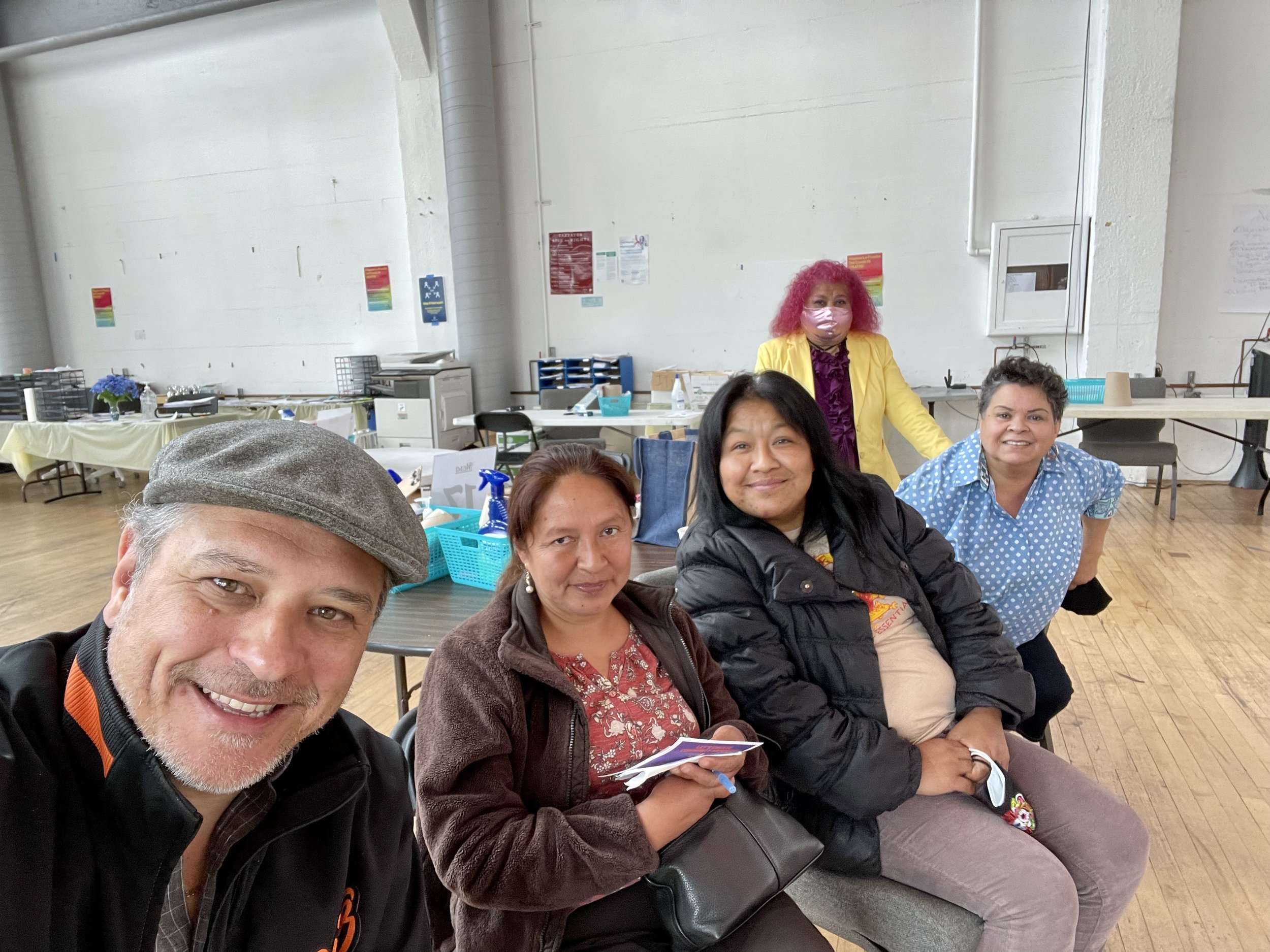
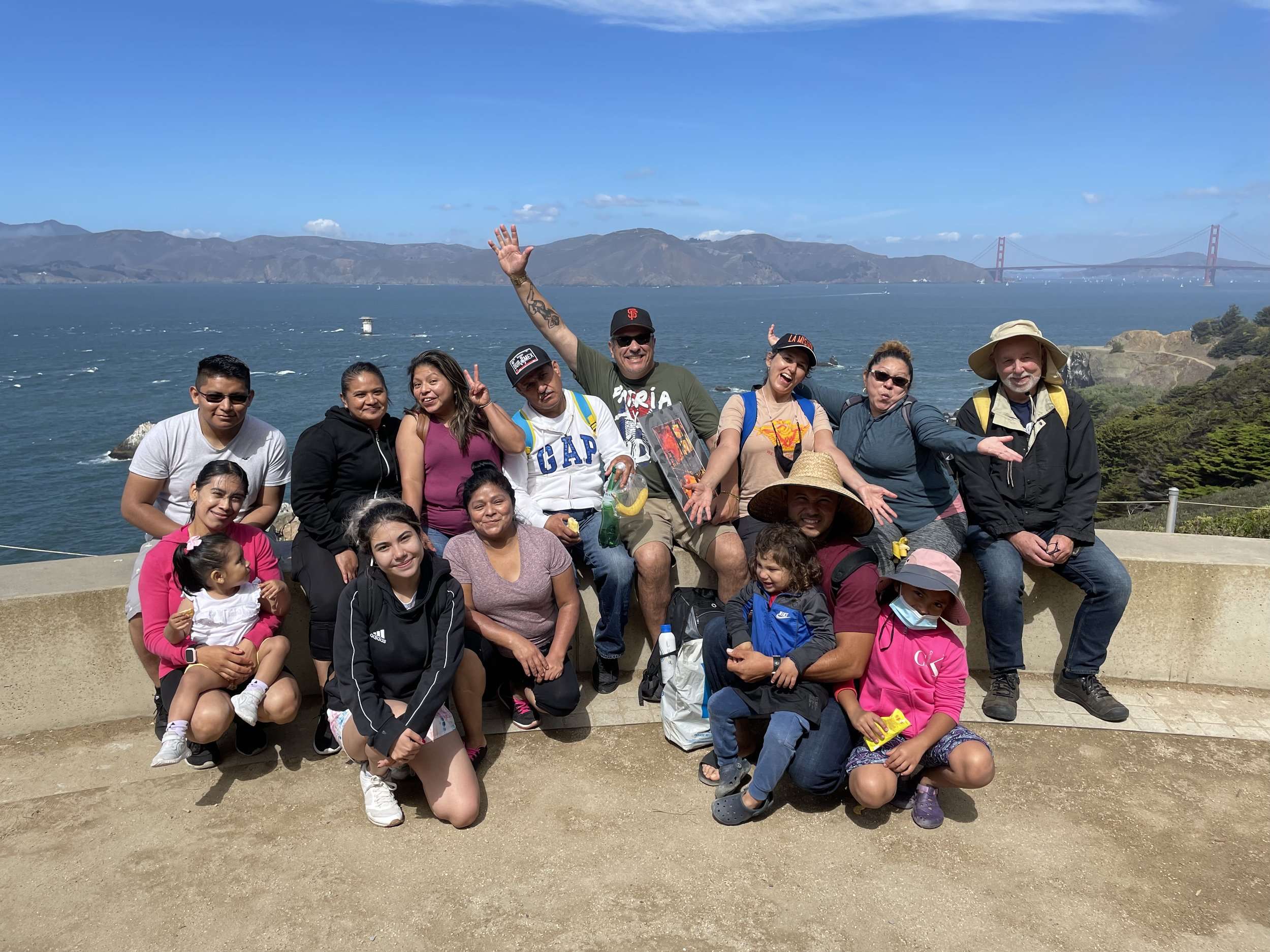
Essential Researchers at the Mission Food Hub after a pivotal dialogue with SF General Hospital Department of Psychiatry and UCSF doctors. Researchers shared their findings about mental health and wellness needs for Latinx workers in the community and were encouraged from the response by the five attending doctors.Essential Researchers take a rest after a long paseo (hike). Hikes were found to be a good mental health practice. Hiking as groups is a practice of convivencia as Essential Researchers get to know each other better outside of the Mission Food Hub.